Research & Framework
Bridging classical Islamic jurisprudence (Fiqh) with modern quantitative finance: the Computational Wakil framework.
The Five Arkan Lifecycle
Translating religious wealth management obligations into modular computational logic
Wealth Creation
Employ an active gatekeeper to validate source of funds (SoF), screen employer industries, and analyze professional income metadata against sector-risk blacklists.
Accumulation
Automated direct indexing and multi-standard equity screening (AAOIFI, MSCI, SC Malaysia, S&P, DSES) with live trade compliance and asset-tangibility checks.
Protection
Sentinel active surveillance, Takaful gap analysis, and cybersecurity protocols (Cyber-Hifz al-Mal) computing a dynamic Financial Immunity Score.
Purification
Intent-based Zakat calculations (Investor vs. Trader) paired with mandatory dividend and recommended capital gains purification.
Distribution
Rule-governed inheritance calculators (supporting Hanafi Faraid, Khuntha dual-simulation, and Mawquf reserves) with strict debt-clearance and bequest limits.
Theological & Qualitative Breakthroughs
Moving beyond opaque "Black Box" algorithms to transparent, self-governing ShariaTech
"Fiqh-as-Code" Engine
Translates complex Hanafi jurisprudence into deterministic code. Includes a Faraid (Inheritance) Dual Simulation that applies Abu Hanifa's principle of caution (Ihtiyat) to calculate the lesser of two shares (Akhass al-Nasibayn) for intersex heirs (Khuntha Mushkil), suspending surplus funds as legally reserved (Mawquf).
The "Digital Wakil" Agency
Positions the software as an automated agent (Wakil) under AAOIFI Standard 23. Grounded in Articles 1459, 1461, and 89 of the Majallah al-Ahkam al-Adliyah (Ottoman Civil Code), programmatic actions are legally and religiously attributed to the human principal, establishing clear fiduciary liability.
Glass Box Compliance
Replaces binary "Halal/Haram" labels with a fully auditable compliance kernel (TheologyService.ts). Every automated purification or transaction logs its exact theological traceability chain—pointing directly to the Quranic verse, Hadith, or classical maxim (e.g., Al-Yaqin la Yazul bi al-Shakk) governing the rule.
Quantitative Validation & Limitations
Subjected to a 15-year Walk-Forward Validation on the Dhaka Stock Exchange (DSE), the framework demonstrated strong financial immunity and capital preservation under simulated conditions:
- 🏛️ Institution: Islamic University, Bangladesh
- 📜 Methodology: Design Science Research (DSR)
- ⚙️ Rigor: Hanafi Jurisprudential Calibration
- 📊 Backtest: 15-Year Walk-Forward (2010–2024)
- 🧬 Engine: Rule-Based Compliance Core
Symposium Presentation
Presented at the 2026 MTIS Research Symposium.
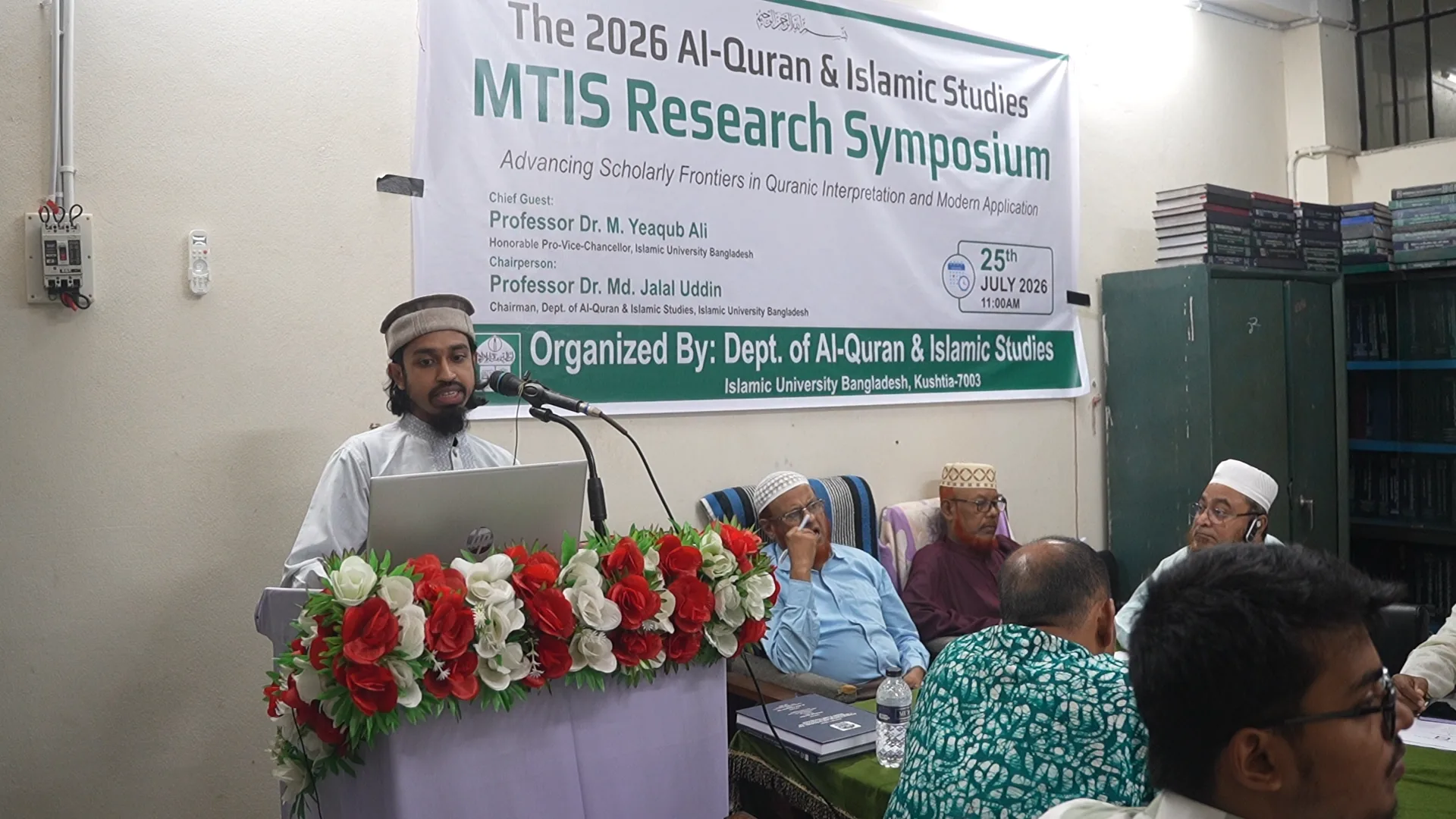
"Bridging Theology and Technology: The Computational Wakil Framework for Islamic Wealth Management"
"Advancing Scholarly Frontiers in Quranic Interpretation and Modern Application"
- Chairperson: Prof. Dr. Md. Jalal Uddin (Dept. Chairman)
- Supervisor: Prof. Dr. Khan Muhammad Ylias
- Date: July 25, 2026
Commendation from departmental professors evaluating the research presentations delivered by the MTIS scholars:
"Today's arrangement was one of the most enjoyable moments in my teaching career."
"Presentation is an art, and their performance reached an artistic level."
@thesis{abusaied2026computationalwakil,
  author = {Muhammad Abu Saied},
  title = {The Computational Wakil Framework for Islamic Wealth Management},
  school = {Islamic University, Bangladesh},
  department = {Department of Al-Quran & Islamic Studies},
  year = {2026},
  type = {Master's Thesis Research},
  note = {Presented at MTIS Research Symposium. Supervised by Prof. Dr. Khan Muhammad Ylias},
  url = {https://abusaied.com/research}
}
Media Mentions
- • Daily Naya Diganta (National Print Edition, Page 3, July 26, 2026 issue)Online Article ↗|e-Paper Page 3 ↗
- • Daily Inqilab — "ইবিতে আল কুরআন বিভাগে সিম্পোজিয়াম"Read Report ↗
- • Daily Sangram — "ইবির আল-কুরআন বিভাগে আন্তর্জাতিক মানের সিম্পোজিয়াম"Read Report ↗
Active Research & Next Steps
📚 Scholarly Pipeline
Actively developing a multi-paper research series derived from the core thesis, targeting peer-reviewed journals in Islamic finance, computational law, and AI ethics.
✍️ Framework Enhancement
Continuously strengthening the IWM compliance engine with expanded AAOIFI standard coverage, refined screening logic, and localized regulatory alignment.
🚀 Long-Term Vision
Working toward transitioning the framework from an academic prototype to a live, regulated platform for Shariah-compliant capital markets.